
Swat’s Jahanabad Buddha smiles despite Taliban efforts to destroy it

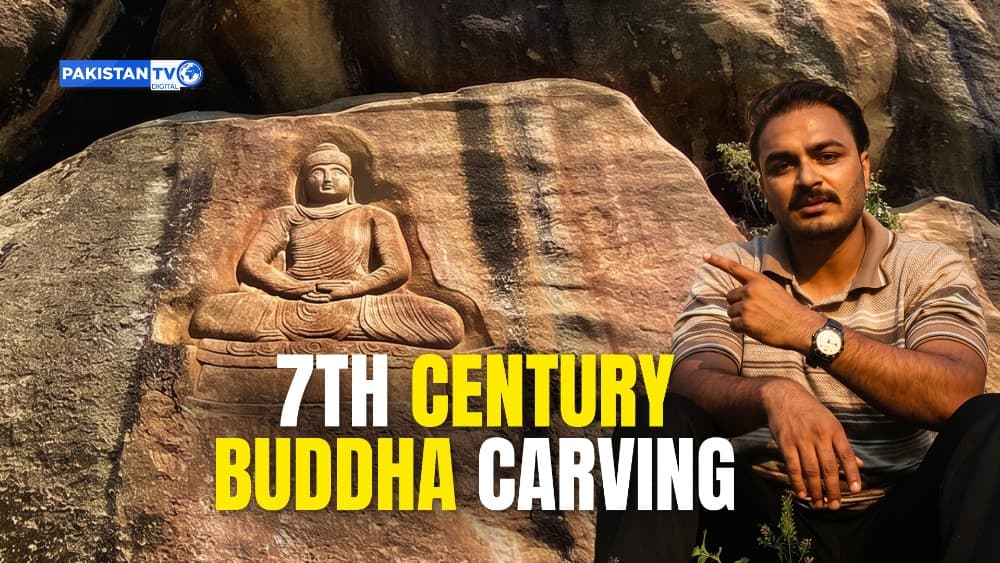
ISLAMABAD: In October 2016, nine years after Taliban militants climbed a cliff in Jahanabad, Swat, and detonated explosives into its face, a 1,400-year-old Buddhist carving looked out over the valley again.
The restoration — carried out by the Italian Archaeological Mission in Swat using laser scanning, 3D surveying technology, and archival photographs taken by British explorer Aurel Stein in 1926 — took four years to complete.
Teams mapped every missing section and physically reconstructed the face using fragments recovered from the valley floor. Some of the original blast damage was left deliberately visible.
The work closed a chapter that had begun in September 2007, when militants drilled holes into the Buddha's face and shoulders and packed them with dynamite. The explosion destroyed the nose, the eyes, and the entire upper face. The charges wired into the shoulders failed to detonate, leaving the torso intact.
What the Taliban targeted was the largest seated Buddhist carving in South Asia — a seven-metre figure cut directly into a reddish cliff face in Jahanabad, Swat, during the Gandhara period in the 7th or 8th century CE.
The sculpture depicts the Buddha in dhyana mudra — legs crossed, hands resting in the lap. It features snail-shell curls, a prominent ushnisha topknot, long earlobes, and intricately folded robes, all hallmarks of the Gandhara artistic tradition.
The head is carved disproportionately large — a deliberate technique to correct for perspective. Viewed from the valley floor, the proportions appear balanced: a 1,400-year-old optical illusion engineered into stone.
The site sits in what was historically known as Uddiyana. Many Western scholars, including Laurence Waddell, Sylvain Lévi, and Giuseppe Tucci, have identified Uddiyana as the Swat Valley — a region regarded in Tibetan Buddhist traditions as a source of many tantric teachings and the birthplace of Padmasambhava, the monk credited with spreading Vajrayana Buddhism to Tibet, Bhutan, and other parts of Southeast Asia.
A 13th-century Tibetan pilgrim named Orgyanpa — whose name means "the man of Uddiyana" — travelled to Swat specifically to document its sacred sites, describing temples and stone images near present-day Manglawar.
When Stein visited Jahanabad in 1926, there were no roads to the site. He rode through the Swat River on horseback to reach the cliff. The photographs and records he produced would prove critical nearly a century later: without them, the 2012 restoration effort would have had no baseline from which to reconstruct the missing face.
The episode drew comparisons to the Taliban's demolition of the Bamiyan Buddhas in Afghanistan in 2001. Unlike Bamiyan, this carving survived — preserved in part because a British archaeologist had documented it a century earlier, and because an Italian archaeological mission had spent decades working the surrounding terrain.
The Italian Archaeological Mission has been operating in Swat since 1955. The Taliban arrived in 2007. The carving has faced the valley and the sunset ever since.
Latest News
Venezuela quake death toll exceeds 5,000: Govt
5 MINUTES AGO
India in early stages of genocide, says expert
37 MINUTES AGO

US ends its state of emergency over Hong Kong security threat
3 HOURS AGO

Pakistan hosts SCO border authorities meeting in Islamabad
4 HOURS AGO
.jpg&w=3840&q=75)
Turkish petroleum to begin oil and gas exploration in Pakistan in October: Minister
5 HOURS AGO