


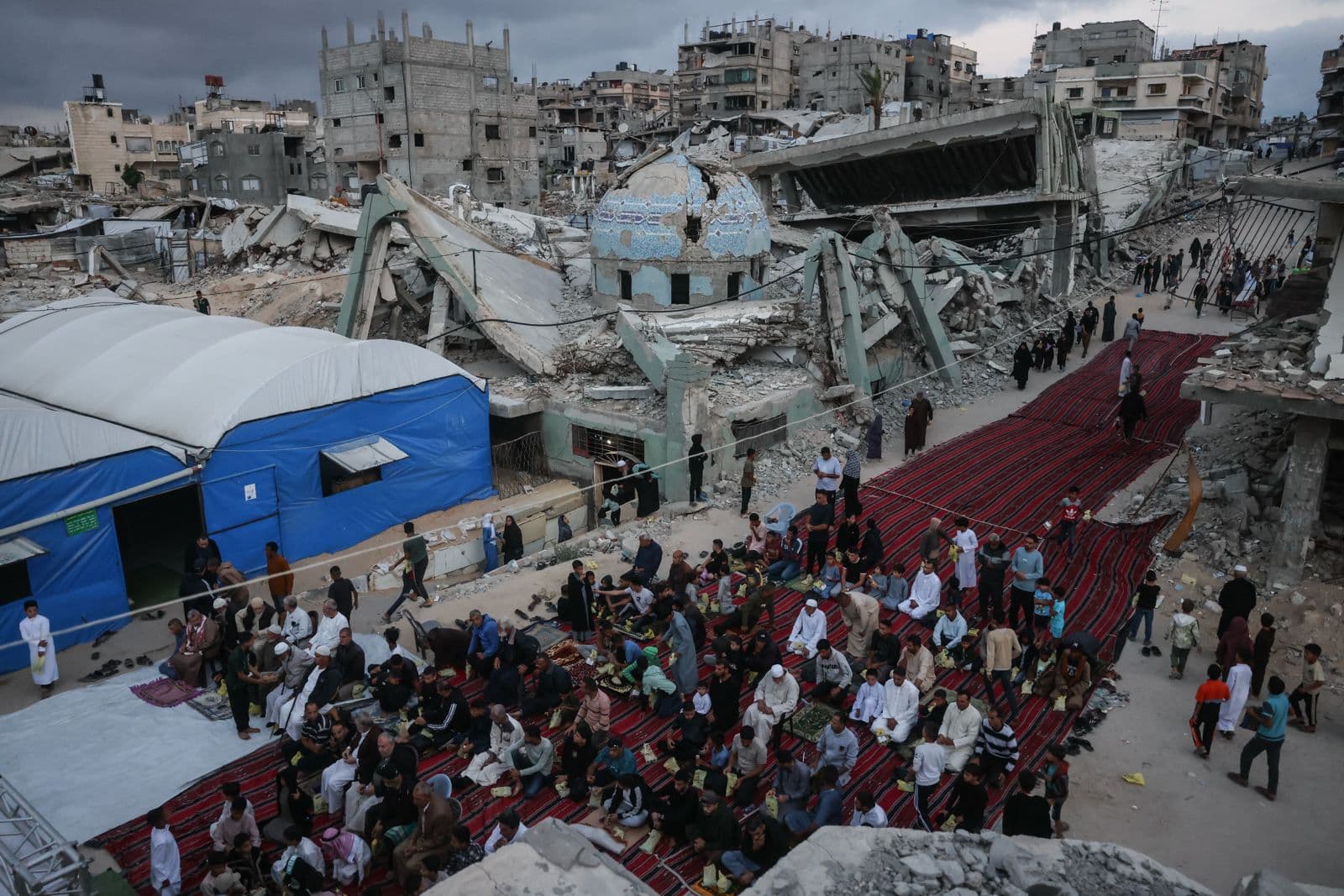
ISLAMABAD: As Eid al-Adha approaches, millions of Muslims living in conflict zones and displacement camps continue to observe the festival despite circumstances shaped by war, hunger and displacement.
In the besieged and bombarded territories of Palestine, famine-hit regions of Sudan, and camps scattered across Syria and Yemen, the rituals of Eid persist even where normal life has largely collapsed.
According to the Elham Fund, Gaza resident Nahidh Abu Armaneh said his family woke up to the sound of Takbeer, wore their best clothes “even if they weren’t new,” and gathered for Eid prayers.
“We started by greeting everyone we met, whether we knew them or not, because people especially need kindness and peace in these times,” he said.
“After that, we visited relatives to extend our Eid wishes, ate sweets and drank coffee, though the coffee tasted as bitter as our lives.”
Nahidh and millions of others across conflict zones, displacement camps and war-damaged cities continue observing Eid al-Adha each year under conditions that would ordinarily make celebration unimaginable.
In peaceful societies, Eid al-Adha is built around abundance and sharing.
To commemorate Prophet Ibrahim’s willingness to sacrifice his son in obedience to Allah, Muslims slaughter livestock animals and traditionally divide the meat into three portions: one for the household, one for relatives and neighbors, and one for the poor.
The ritual centers on generosity flowing outward from the family to the wider community.
But in war zones where many families have lost homes, livelihoods and livestock, the practice increasingly depends on humanitarian aid.
According to Islamic Relief Worldwide, Sudan is facing the world’s largest displacement crisis, with nearly 14 million people uprooted by conflict and famine conditions reported in parts of Darfur.
The organization said Eid al-Adha meat distributions had become the only source of meat for many displaced families, with its Qurbani program reaching 3.2 million people across 29 countries in 2025.
“Eid al-Adha means everything to me,” displaced Sudanese resident Halima said in a statement released by the organization, adding that she did not expect to eat meat this year.
In Syria and Yemen, where wars have stretched on for more than a decade, Eid al-Adha has become an annual confrontation with memory and loss.
According to Al Jazeera, Umm Ghadi, a displaced Syrian mother living in an Idlib camp, gathered with neighbors to prepare sweets for children ahead of Eid despite harsh camp conditions.
“At the camp, there is no joy for the Eid, but we need to make the children happy,” she said. “Eid al-Adha in the villages is nicer.”
In Yemen, Abdul-Raqeeb al-Samey traveled through front-line areas to return to his home village in Taiz after purchasing a traditional jambiya — a ceremonial dagger worn during Eid celebrations — in Sanaa, according to Al Jazeera.
Meanwhile in Syria, former residents of the remote Rukban displacement camp returned home for Eid only to find destroyed houses and devastated neighborhoods.
According to Al Jazeera, Yasmine al-Salah returned home during Eid al-Adha 2025 after spending nine years in the camp.
“Even though our house is destroyed, and we have no money, and we are hungry, still, it’s a castle in my eyes,” she said.
Across these conflict zones, Eid functions not as denial of suffering but as an insistence that interrupted lives are not extinguished lives.
What unfolds during Eid al-Adha in such places reflects something central to the story of Prophet Ibrahim: the ability to move through catastrophe while refusing to surrender hope entirely.
This is not simple optimism. While optimism assumes improvement, people living through war often continue their traditions fully aware of destruction around them, choosing meaning despite devastation.
For many trapped in conflict, the acts of washing, dressing, praying and sharing whatever food remains become assertions of dignity and humanity against conditions designed to strip both away.
None of these moments erase the catastrophes surrounding them. Hunger, displacement and violence persist. Yet the prayers are still offered, sweets are still prepared and families still gather where they can.
In places shaped by siege and loss, Eid al-Adha becomes more than a religious celebration.
For many, it is also a quiet declaration that war has not succeeded in erasing faith, memory or the will to endure.