Dushanbe declaration urges faster action on mounting global water crisis
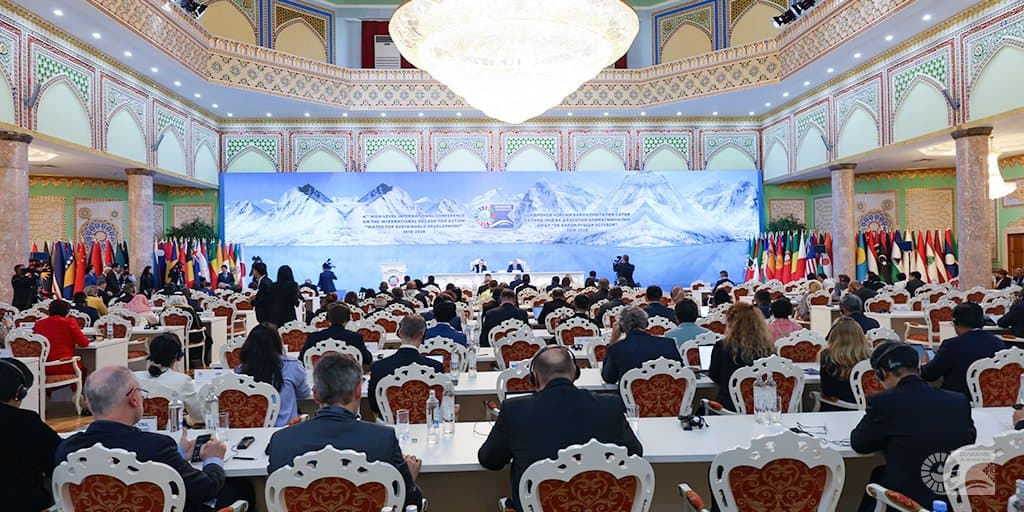
The fourth International High-Level Conference of the Dushanbe Water Process in Dushanbe on May 27, 2026. (X/@DWaterProcess)
DUSHANBE: A major United Nations-backed water conference concluded in Tajikistan this week with renewed calls to accelerate progress on global water targets, strengthen climate resilience and boost financing for water security, as governments and international organizations warned the world remains off track to achieve key development goals.
The Fourth High-Level International Conference on the International Decade for Action “Water for Sustainable Development” (2018–2028) brought together around 2,500 participants from 110 countries, according to organizers.
Over three days, delegates focused on water security, climate-related risks, financing gaps and implementation of Sustainable Development Goal 6 (SDG 6), which aims to ensure universal access to clean water and sanitation.
The conference concluded with the adoption of the Dushanbe Declaration, a political outcome document intended to guide preparations for the 2026 UN Water Conference and support ongoing negotiations under the global water agenda.
A Co-Chairs’ Summary and an additional contribution document will also feed into the 2026 process.
The gathering underscored growing international concern that water challenges are increasingly intersecting with climate change, food security, energy production and sustainable development, while progress toward global water targets continues to lag behind commitments.
Opening the conference, Tajik President Emomali Rahmon described water as a central global development priority and highlighted his country's long-standing role in advancing water-related initiatives at the United Nations.
He said Tajikistan had helped keep water high on the international agenda through a series of UN-backed initiatives and resolutions, while promoting the Dushanbe Water Process as a platform for dialogue, cooperation and improved water governance.
Speaking at a closing briefing, Prime Minister Kokhir Rasulzoda said the conference had served as an important platform for reviewing progress on water and climate issues and strengthening partnerships ahead of the 2026 UN Water Conference in the United Arab Emirates.
He said discussions focused on accelerating implementation of the Water Action Decade and advancing progress toward SDG 6 targets.
According to organizers, the event attracted approximately 1,100 foreign participants, alongside representatives from 75 international and regional organizations and 170 non-governmental organizations and academic institutions.
Conference sessions examined integrated water resources management, access to water and sanitation, transboundary cooperation, financing mechanisms, innovation and the links between water systems, climate change and broader sustainable development priorities.
A recurring message throughout the conference was that global progress remains insufficient.
Speaking to Pakistan TV Digital, United Nations Under-Secretary-General and Executive Secretary of the UN Economic and Social Commission for Asia and the Pacific (ESCAP), Armida Salsiah Alisjahbana, said countries remain “off track” in achieving SDG 6 despite growing awareness of water-related risks.
She said the conference provided an opportunity for countries to exchange experiences, share solutions and scale up successful approaches across regions.
Water and industrial development also emerged as key themes.
Dr. Natalie Degger of the United Nations Industrial Development Organization (UNIDO) stressed that water scarcity could not be addressed without stronger cooperation across sectors, noting that industrial production remained heavily dependent on water availability.
“Water is for peace. Water unites us all,” she told Pakistan TV Digital, adding that greater private-sector participation would be essential to improving efficiency and addressing future water challenges.
Tajikistan Energy and Water Resources Minister Daler Juma said the Dushanbe Water Process had evolved into a recurring mechanism for reviewing progress, identifying gaps and aligning international efforts with future milestones, including the 2026 UN Water Conference and a planned UN water conference in Tajikistan in 2028.
He said the process enabled countries to assess achievements, identify shortcomings and explore new opportunities as they worked toward long-term water goals.
The conference concluded with participants reaffirming commitments to international cooperation and sustainable water management through the Dushanbe Declaration.
Officials said additional outcome documents, including the Co-Chairs’ Summary, would be submitted as contributions to preparations for the 2026 UN Water Conference.
While governments reiterated their commitment to global water goals, delegates acknowledged that achieving them would require faster implementation, increased financing and stronger cross-border cooperation in the years ahead.
Latest News
Far-right Australian politician loses appeal in racism case
AN HOUR AGO
Polling begins across Mirpur Division in first phase of Azad Jammu and Kashmir elections
6 HOURS AGO

Iran halts strikes as Trump gives space to talks
14 MINUTES AGO
.jpg&w=3840&q=75)
Masood leads Pakistan to 199-3 against West Indies
9 HOURS AGO

Pakistan president, PM pay tribute to Capt Sarwar on martyrdom anniversary
AN HOUR AGO