

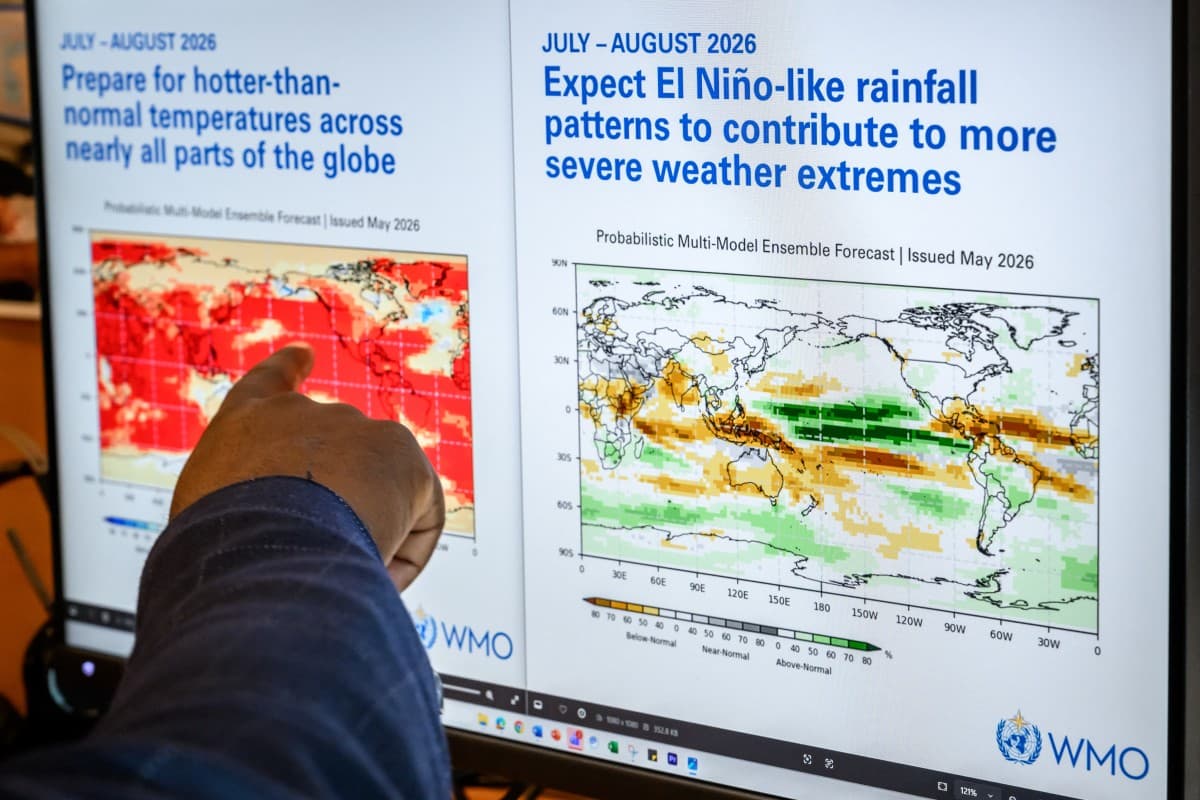
Head of climate prediction services at the World Meteorological Organization (WMO) Wilfran Moufouma-Okia points on graphs displayed on a computer screen at the WMO headquarters in Geneva, on June 1, 2026. (AFP)
GENEVA: There is an 80% chance of the warming El Nino phenomenon developing between June and August, increasing the risk of extreme weather events, the World Meteorological Organization said Tuesday.
"Fuelled by unusually warm ocean waters in the tropical Pacific, El Nino conditions are developing and are set to influence global temperature and rainfall patterns," the United Nations' weather and climate agency said.
Forecasts from the WMO global network "indicate a pronounced shift toward El Nino conditions, with probabilities reaching 80% for June-August", the Geneva-based organization said.
El Nino is a natural climate phenomenon that warms surface temperatures in the central and eastern equatorial Pacific Ocean, bringing worldwide changes in winds, pressure and rainfall patterns.
It typically takes place every two to seven years and lasts around nine to 12 months.
Conditions oscillate between El Nino and its opposite La Nina, with neutral conditions in between.
The likelihood of El Nino developing by November is "near or above 90%", and most forecast models suggest it will be "at least moderate and possibly strong", the WMO said in its quarterly El Nino/La Nina update.
WMO chief Celeste Saulo said the world therefore needed to get ready for an El Nino which could "exacerbate drought and heavy rainfall and increase the risk of heatwaves both on land and in the ocean".
The WMO says that even a moderate El Nino makes some weather and climate extremes more likely.
The last El Nino contributed to making 2023 the second-hottest year on record and 2024 the all-time high at around 1.55C above the 1850-1900 pre-industrial average.
'Urgent climate warning': Guterres
In late April to mid-May, the sea-surface temperature in the central-eastern Equatorial Pacific, the area used as a monitoring reference, was approaching El Nino thresholds, the WMO said, with sub-surface temperatures more than 6C above average.
Meanwhile, the Southern Oscillation Index, the atmospheric component of El Nino, is also consistent with El Nino conditions developing.
The WMO said there was no evidence that climate change increases the frequency or intensity of El Nino events.
However, it can amplify the associated impacts, it says, because a warmer ocean and atmosphere increase the availability of energy and moisture for extreme weather events, such as heatwaves and heavy rainfall.
"El Nino is arriving on our doorstep," UN chief Antonio Guterres said in a video message.
"The world must treat it as the urgent climate warning it is. El Nino conditions will pour fuel on the fire of a warming world. Impacts will hit even harder, travel even farther, and cross borders with devastating speed.
"The only effective response is climate action equal to the crisis, ending the addiction to fossil fuels, accelerating the shift to renewables, protecting the most vulnerable, and delivering early warning systems for all."
Temperatures above normal
The WMO said that for June to August, forecasts project "a nearly universal dominance of above normal temperatures in nearly all parts of the globe".
This increases the risk of compounding hazards in some regions and accelerates the onset of drought conditions where rainfall is reduced, it said.
Regional climate centers are predicting "below-normal" rainfall during the critical June-September rainy season in the northern Greater Horn of Africa; below-average monsoon rainfall in South Asia; and drier and warmer summer conditions in Central America.
During the northern hemisphere summer, warm waters associated with El Nino can fuel hurricanes in the central and eastern Pacific, while hindering their development in the Atlantic Ocean.
The WMO hopes advance warning will guide preparedness, especially in climate-sensitive sectors like agriculture, water management, energy and health.
Each El Nino is unique, says WMO's climate prediction chief
AFP spoke with Wilfran Moufouma Okia, head of climate prediction at the United Nations' weather and climate agency, who said Tuesday that warming El Nino conditions were expected to develop before the end of August.
The natural climate phenomenon is expected to drive more extreme weather and rainfall, according to the WMO, although its intensity is hard to predict at this stage.
What can we expect?
Moufouma Okia said El Nino has a temporary warming effect, and while it originates in the tropics, it affects a large part of the planet.
"When El Nino occurs, droughts are expected in West Africa, the Sahel, South Africa, Australia, and Southeast Asia," he said.
"Conversely, other regions experience abundant rainfall, such as the southeastern United States and especially the equatorial Pacific region. Therefore, different regions will react differently to the phenomenon."
Moufouma Okia stressed that El Nino does not act in isolation, but interacts with other weather phenomena, which can amplify or weaken its intensity.
"According to our projections, we will broadly see an El Nino event ranging from moderate to strong," he said.
"But it's important to stress that each El Nino event is unique. One might think that a weak El Nino will have no consequences, but that's wrong. Depending on the country and the context, the consequences can be just as damaging as with strong events."
Are countries ready?
Moufouma Okia said the WMO would provide countries and national weather services with its findings, but it was down to them to refine the information at a local level.
He hoped countries would take the data into account in preparing for El Nino.
"WMO models are capable of making forecasts six months in advance. So we hope that countries will have had time to anticipate," he said.
However, sometimes the consequences go beyond a country's capacity to respond, as happened during the last El Nino, between 2023 and 2024.
"Back then, there was a decrease in rainfall in Panama that affected the canal, and therefore the global economy," he said.
Are countries cooperating on weather?
Moufouma Okia said there was progress, with countries exchanging more information regarding El Nino.
"There were fewer casualties in 2023-2024 than in 1997. So we can assume that countries are better prepared, or have learned from previous events," he said.
Countries understand the need to share data, and "even countries in conflict" are cooperating, the climate prediction chief said.
"To predict a phenomenon on the other side of the world, you need data from the other side."
Latest News
2.4 million girls banned from Afghan schools since Taliban return: UNESCO
3 HOURS AGO
Five terrorists killed in intelligence-based operation in Balochistan’s Panjgur
4 HOURS AGO
Syria sentences Bashar al-Assad to death in absentia over atrocities
5 HOURS AGO
King Salman hails Makkah pact as long-term Saudi-Türkiye-Pakistan partnership
5 HOURS AGO
Sony, TSMC to invest $4.7B in advanced image sensors
6 HOURS AGO